Paris, City of Dreams
Napoleon III, Baron Haussmann, and the Creation of Paris
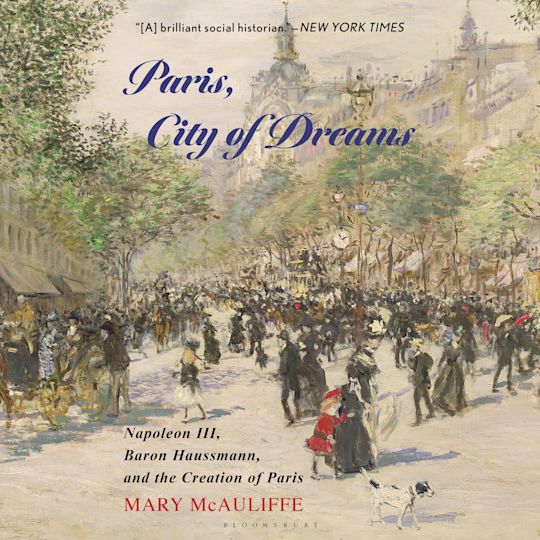

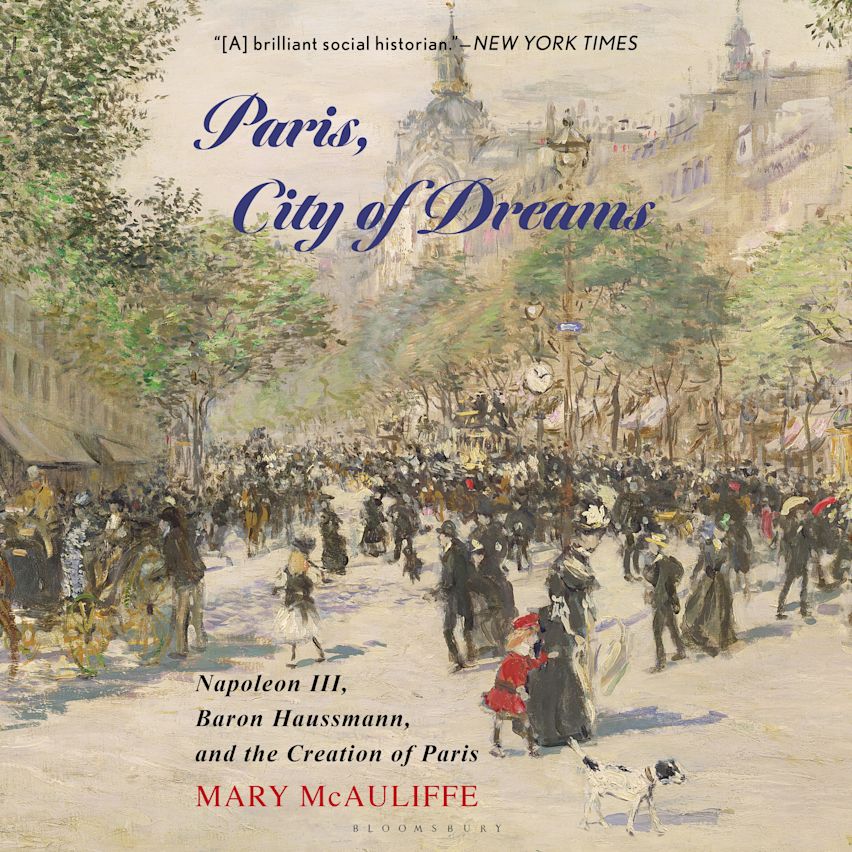
Paris, City of Dreams
Napoleon III, Baron Haussmann, and the Creation of Paris
Description
Bloomsbury presents Paris, City of Dreams by Mary McAuliffe, read by Tim H. Dixon.
"Armchair historians in particular will appreciate McAuliffe's readable yet detailed history" Booklist, Starred Review
Acclaimed historian Mary McAuliffe vividly recaptures the Paris of Napoleon III, Claude Monet, and Victor Hugo as Georges Haussmann tore down and rebuilt Paris into the beautiful City of Light we know today.
Paris, City of Dreams traces the transformation of the City of Light during Napoleon III's Second Empire into the beloved city of today. Together, Napoleon III and his right-hand man, Georges Haussmann, completely rebuilt Paris in less than two decades-a breathtaking achievement made possible not only by the emperor's vision and Haussmann's determination but by the regime's unrelenting authoritarianism, augmented by the booming economy that Napoleon fostered.
Yet a number of Parisians refused to comply with the restrictions that censorship and entrenched institutional taste imposed. Mary McAuliffe follows the lives of artists such as Edouard Manet, Berthe Morisot, and Claude Monet, as well as writers such as Emile Zola, Gustave Flaubert, and the poet Charles Baudelaire, while from exile, Victor Hugo continued to fire literary broadsides at the emperor he detested.
McAuliffe brings to life a pivotal era encompassing not only the physical restructuring of Paris but also the innovative forms of banking and money-lending that financed industrialization as well as the city's transformation. This in turn created new wealth and lavish excess, even while producing extreme poverty. More deeply, change was occurring in the way people looked at and understood the world around them, given the new ease of transportation and communication, the popularization of photography, and the emergence of what would soon be known as Impressionism in art and Naturalism and Realism in literature-artistic yearnings that would flower in the Belle Epoque.
Napoleon III, whose reign abruptly ended after he led France into a devastating war against Germany, has been forgotten. But the Paris that he created has endured, brought to vivid life through McAuliffe's rich and evocative narrative.
Table of Contents
Acknowledgments
Map of Paris, 1860–1870
Introduction
Chapter 1 From Barricades to Bonaparte (1848–1851)
Chapter 2 Blood and Empire (1852)
Chapter 3 Enter Haussmann (1853)
Chapter 4 A Nonessential War (1854)
Chapter 5 A Queen Visits (1855)
Chapter 6 What Goes Up . . . (1856–1857)
Chapter 7 More and More (1858)
Chapter 8 Dreams of Glory (1859)
Chapter 9 Suddenly Larger (1860)
Chapter 10 Turning Point (1861)
Chapter 11 Les Misérables de Paris (1862)
Chapter 12 Scandal (1863–1864)
Chapter 13 Death and Taxes (1865)
Chapter 14 Crisis (1866)
Chapter 15 A Setting Sun (1867)
Chapter 16 Twenty Years Later (1868)
Chapter 17 Haussmann in Trouble (1869)
Chapter 18 Finale (1870)
Chapter 19 An End and a Beginning (1870–1871)
Notes
Bibliography
Index
About the Author
Product details
| Published | Jul 15 2024 |
|---|---|
| Format | Audiobook |
| Duration | 12 hours and 34 minutes |
| ISBN | 9781538151716 |
| Imprint | Rowman & Littlefield Publishers |
| Publisher | Bloomsbury Publishing |
Reviews
Related Titles